![eligo_logo-bicolor-1.png]](https://support.eligo.social/hs-fs/hubfs/eligo_logo-bicolor-1.png?height=38&name=eligo_logo-bicolor-1.png)
If this module is enabled, it is possible to set a predefined ratio between the number of preferences that the voter must assign to male and female candidates.
The system automatically checks that the preferences expressed comply with the defined ratio before allowing the vote to be confirmed.
Configuring gender quota
- Create an electoral event and its related ballots.
In the ballot “type”, select a “candidate” vote and choose the maximum number of preferences (to enable gender parity, generally at least 2 maximum preferences are required).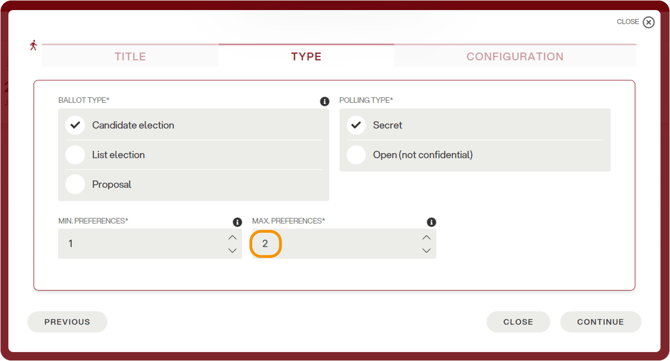
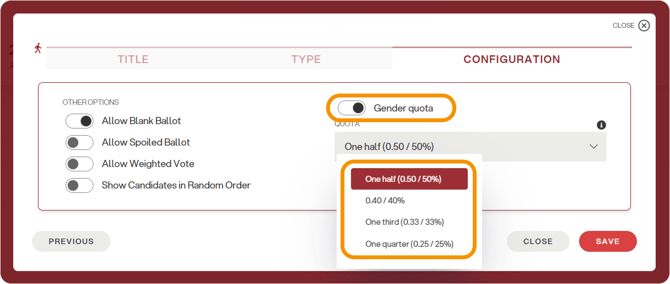
- In the next step (“Configuration”), enable the “Gender quota” toggle and select the desired ratio:
- When entering the candidates, select the gender from the appropriate menu.
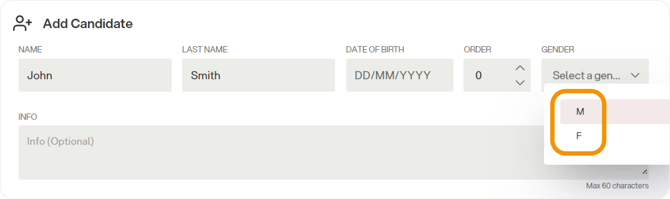
The established ratio will be applied automatically during the voting phase.
Gender quota during voting
While the vote is in progress, the voter can see the gender representation information on the left side of the ballot, while on the right side there is a column indicating the candidate’s gender.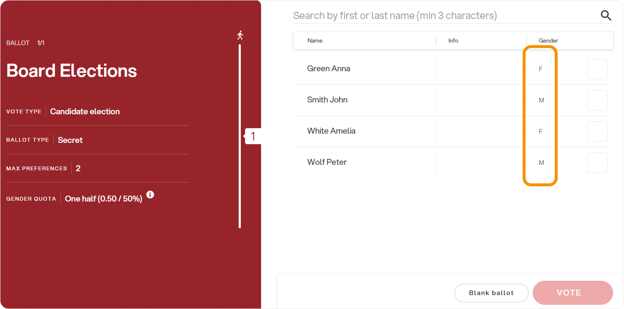
The voter can freely select preferences, but the system prevents vote confirmation if the selected preferences do not respect the configured ratio.
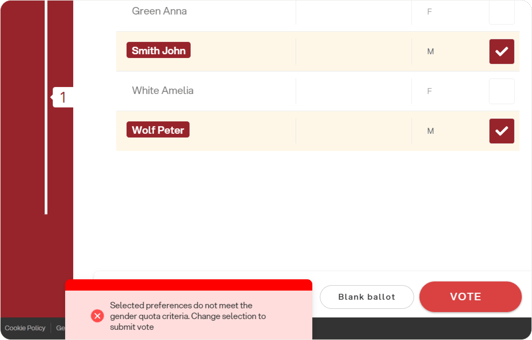
If, on the other hand, gender representation is respected, the system will display the usual screen to proceed with vote confirmation: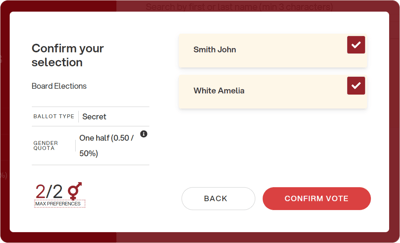
Notes and considerations
-
Unless a minimum number of preferences greater than 2 is set, selecting a single candidate will always be accepted by the system (if only one candidate is selected, only one gender is selected, and therefore there is no “underrepresented gender” on which Eligo must perform a check).
-
This module also works for list votes, not only for candidate votes. Specifically, it works for list votes with list-and-candidate voting or candidate-only voting (it does not work for list-only votes, as candidates would not be selectable).
-
The most commonly used proportions are 50%, but also 40%, 33% (one third), and 25% (one quarter). The check for compliance with gender parity is performed as follows:

| Total selected candidates | F | M | Calculated ratio | Comparison | Configured ratio | Result |
|---|---|---|---|---|---|---|
| 10 | 6 | 4 | 0.40 | < | 0.50 | INVALID VOTE |
| 10 | 5 | 5 | 0.50 | = | 0.50 | VALID VOTE |
| 10 | 8 | 2 | 0.20 | < | 0.25 | INVALID VOTE |
| 10 | 7 | 3 | 0.30 | > | 0.25 | VALID VOTE |
| 10 | 7 | 3 | 0.30 | < | 0.33 | INVALID VOTE |
| 10 | 6 | 4 | 0.40 | > | 0.33 | VALID VOTE |
| 10 | 7 | 3 | 0.30 | < | 0.40 | INVALID VOTE |
| 10 | 6 | 4 | 0.40 | = | 0.40 | VALID VOTE |